Experiment 10: Final Review
You are the consultant
Warm-up
Loading the concept check…
The request
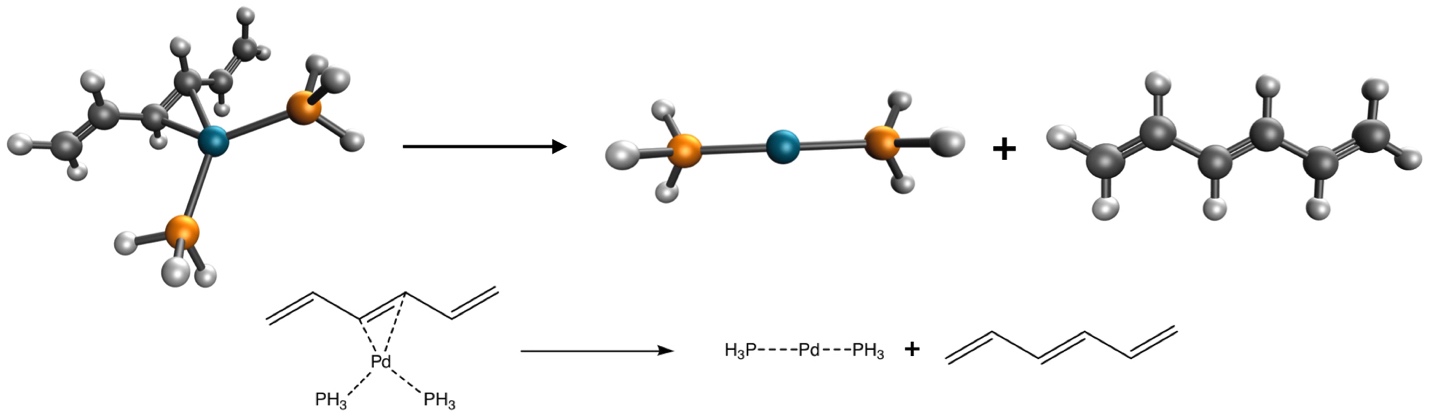
Imagine that a colleague in your department is studying this palladium complex (the structures come from the PdBE2 subset [1] of the Minnesota 2015B database [2]) and asks you to calculate the bond dissociation energy of the reaction above. You are in charge of setting up the calculations.
Choose the functional and basis set based on:
- the published literature, for instance these recent benchmarks [2–11];
- the functionals available in Q-Chem;
- what you learned in Experiments 1–9: basis-set convergence, dispersion, grids, stability analysis.
Remember that every calculation is a compromise between accuracy and computational cost, and the free server stops jobs after 10 minutes. Pd needs an effective core potential (ECP = def2-ECP with the def2 basis sets).
The molecules
Loading…
Predict first
Loading…
Your method card
Choose every setting and write down why. The card warns you about common pitfalls (double-counting dispersion, grid-sensitive functionals) and estimates whether each job fits in the free server’s 10-minute limit. It then gives you the three Q-Chem inputs for your choice.
Loading the method card…
Enter your results
Record the three total energies, SCF cycles and wall times from your outputs, then your bond dissociation energy ΔE = E(Pd(PH₃)₂) + E(C₆H₈) − E(complex).
Loading the results table…
Explore your data
Loading…
Your report
Write a short report (about 300 words) that:
- has a title;
- states the method you chose and why, citing the literature;
- describes the computational setup completely (program, functional, basis set, ECP, grid, stability analysis, convergence criteria), enough for someone else to reproduce your numbers;
- presents your results and compares them with the reference value of 16.20 kcal/mol;
- ends with an appropriate reference section.
Loading the report editor…
Peer review. Your instructor may ask you to review two classmates’ reports on Canvas with a short rubric: is the method justified, is the setup reproducible, is the comparison with the reference honest?
Submit
Loading…