
Experiment 3: Applying DFT to Organic Chemistry – Part A

Rotational barriers, conformers and cis–trans isomers

Four textbook reactions computed with 15 density functionals and Hartree–Fock.

At a glance. 8 molecules × 16 methods = 128 jobs with the def2-TZVP basis, from a few seconds to about 3 minutes each (the diol and pentene with hybrid meta-GGAs are the slowest). Plan to submit them in batches (see working on a shared machine). You will learn how methods on different rungs of Jacob’s ladder perform for “easy” organic reactions, what dispersion corrections do, and what each functional costs.

Warm-up

Loading the concept check…

Background
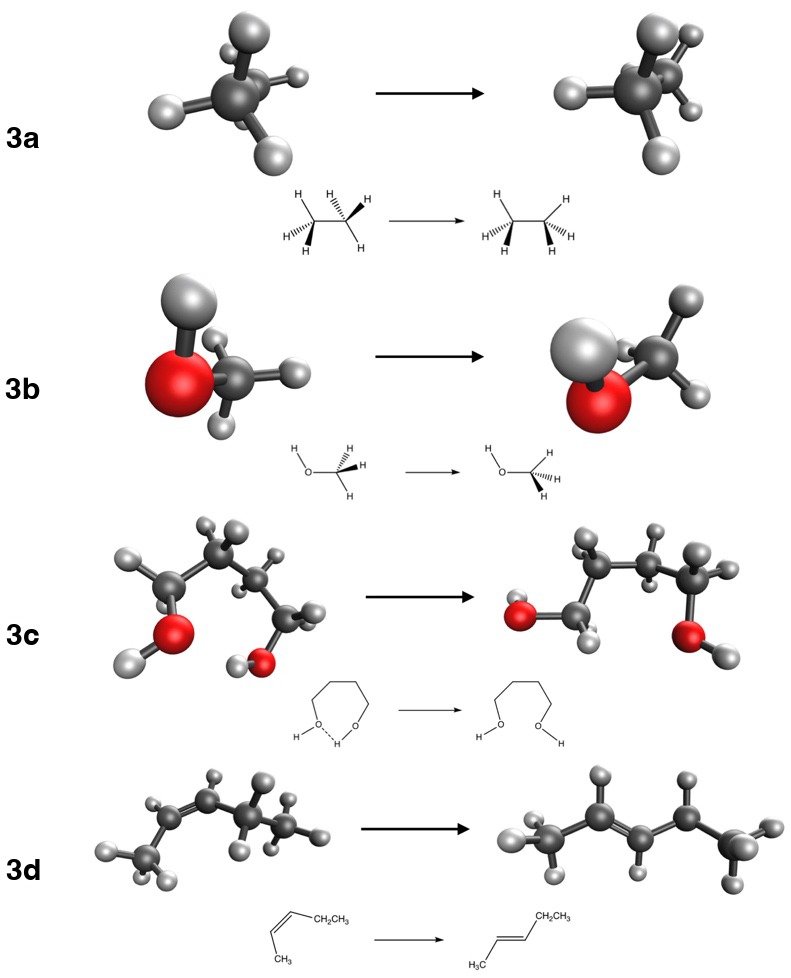
Ball-and-stick and line drawings of the four reactions 3a to 3d

Reactions studied in Experiment 3: rotational barrier of ethane (3a) and methanol (3b), a conformational change of butane-1,4-diol (3c), and the cis–trans isomerization of pent-2-ene (3d). Carbon is black, oxygen red, hydrogen white; dotted lines are hydrogen bonds.

In this experiment you will analyze four reactions found in most introductory organic chemistry textbooks. For 3a you will calculate the energy difference between the staggered and eclipsed conformations of ethane. For 3b you will do the same for methanol. For 3c you will look at a change of conformation in butane-1,4-diol, which breaks an intramolecular hydrogen bond. 3d is the isomerization of cis-pent-2-ene to trans-pent-2-ene. The molecules come from the BHROT27  [1], BUT14DIOL  [2] and FH51  [3,4] subsets of the GMTKN55 database  [1].

The methods are:

  • LSDA: SPW92  [5–7]
  • GGA: BP86  [8–10], BLYP  [8,11], PBE  [12] and PBE-D4  [12–14]
  • meta-GGA: SCAN  [15] and B97M-V  [16,17]
  • hybrid GGA: B3LYP  [8,11,18–20], B3LYP-D4  [13,14], B3PW91  [6–8,19,21] and PBE0  [22,23]
  • hybrid meta-GGA: M06-2X  [24], M11  [25], MN15  [26] and ωB97M-V  [17,27]
  • Hartree–Fock  [28–31]

Use the def2-TZVP basis set  [32] for every calculation.

The reference energies are:

Reaction 3a 3b 3c 3d
ΔEref (kcal/mol) 2.73 1.01 3.29 –1.15

Compute each reaction energy as ΔE = Σ νi Ei, with νi > 0 for products and νi < 0 for reactants (units guide), then the signed error ε = ΔEcomp − ΔEref and the absolute error |ε|.

The molecules

Loading the molecules…

Predict first

Loading…

Run the calculations

Loading the job list…

Enter your results

For every job, record the total energy, the number of SCF cycles and the wall time (where to find them). The page computes the time per SCF cycle for you in the explore section. Then enter your reaction energies in the last tab.

Loading the results table…

Explore your data

Loading…

Questions

Loading the questions…

We will discuss these results more extensively after Experiment 5, when you have seen “easy”, “medium” and “hard” reactions.

Go further (optional)

Scan the full ethane rotation. Reaction 3a compares just two points on a curve. In this Colab notebook you rotate one methyl group from 0° to 120°, compute the whole torsional profile with PySCF, and see where the barrier comes from. Open in Colab

Submit

Loading…

Back to top

References

[1]
L. Goerigk, A. Hansen, C. Bauer, S. Ehrlich, A. Najibi, and S. Grimme, Phys. Chem. Chem. Phys. 19, 32184 (2017).
[2]
S. Kozuch, S. M. Bachrach, and J. M. L. Martin, J. Phys. Chem. A 118, 293 (2014).
[3]
J. Friedrich and J. Hänchen, J. Chem. Theory Comput. 9, 5381 (2013).
[4]
J. Friedrich, J. Chem. Theory Comput. 11, 3596 (2015).
[5]
J. C. Slater, Phys. Rev. 81, 385 (1951).
[6]
J. P. Perdew and Y. Wang, Phys. Rev. B 45, 13244 (1992).
[7]
J. P. Perdew and Y. Wang, Phys. Rev. B 98, 079904 (2018).
[8]
A. D. Becke, Phys. Rev. A 38, 3098 (1988).
[9]
J. P. Perdew, Phys. Rev. B 33, 8822 (1986).
[10]
J. P. Perdew, Phys. Rev. B 34, 7406 (1986).
[11]
C. Lee, W. Yang, and R. G. Parr, Phys. Rev. B 37, 785 (1988).
[12]
J. P. Perdew, K. Burke, and M. Ernzerhof, Phys. Rev. Lett. 77, 3865 (1996).
[13]
E. Caldeweyher, C. Bannwarth, and S. Grimme, J. Chem. Phys. 147, 034112 (2017).
[14]
E. Caldeweyher, S. Ehlert, A. Hansen, H. Neugebauer, S. Spicher, C. Bannwarth, and S. Grimme, J. Chem. Phys. 150, 154122 (2019).
[15]
J. Sun, A. Ruzsinszky, and J. P. Perdew, Phys. Rev. Lett. 115, 036402 (2015).
[16]
N. Mardirossian and M. Head-Gordon, J. Chem. Phys. 142, 074111 (2015).
[17]
O. A. Vydrov and T. Van Voorhis, J. Chem. Phys. 133, 244103 (2010).
[18]
S. H. Vosko, L. Wilk, and M. Nusair, Can. J. Phys. 58, 1200 (1980).
[19]
A. D. Becke, J. Chem. Phys. 98, 5648 (1993).
[20]
P. J. Stephens, F. J. Devlin, C. F. Chabalowski, and M. J. Frisch, J. Phys. Chem. 98, 11623 (1994).
[21]
J. P. Perdew, J. A. Chevary, S. H. Vosko, K. A. Jackson, M. R. Pederson, D. J. Singh, and C. Fiolhais, Phys. Rev. B 46, 6671 (1992).
[22]
C. Adamo and V. Barone, J. Chem. Phys. 110, 6158 (1999).
[23]
M. Ernzerhof and G. E. Scuseria, J. Chem. Phys. 110, 5029 (1999).
[24]
Y. Zhao and D. G. Truhlar, Theor. Chem. Acc. 120, 215 (2008).
[25]
R. Peverati and D. G. Truhlar, J. Phys. Chem. Lett. 2, 2810 (2011).
[26]
H. S. Yu, X. He, S. L. Li, and D. G. Truhlar, Chem. Sci. 7, 5032 (2016).
[27]
N. Mardirossian and M. Head-Gordon, J. Chem. Phys. 144, 214110 (2016).
[28]
D. R. Hartree, Math. Proc. Camb. Philos. Soc. 24, 89 (1928).
[29]
D. R. Hartree, Math. Proc. Camb. Philos. Soc. 24, 111 (1928).
[30]
V. Fock, Z. Phys. 61, 126 (1930).
[31]
J. C. Slater, Phys. Rev. 35, 210 (1930).
[32]
F. Weigend and R. Ahlrichs, Phys. Chem. Chem. Phys. 7, 3297 (2005).