Experiment 4: Applying DFT to Organic Chemistry – Part B
Diels–Alder, alkane isomers and dispersion-bound dimers
Warm-up
Loading the concept check…
Background
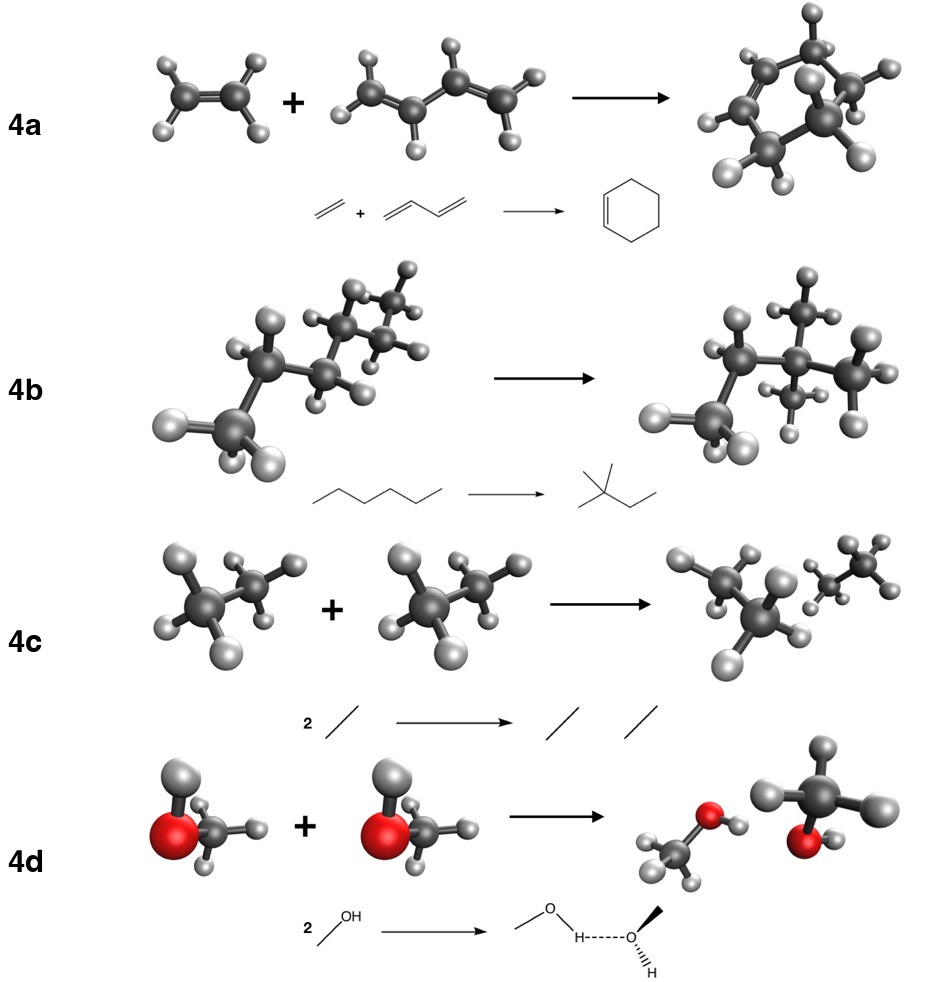
In this experiment you will deal with four more organic reactions commonly found in textbooks:
- 4a: the Diels–Alder reaction between ethene and butadiene to give cyclohexene, ΔEref = –45.40 kcal/mol.
- 4b: the isomerization of n-hexane to neohexane (2,2-dimethylbutane), ΔEref = –2.49 kcal/mol.
- 4c: the formation of the ethane dimer, held together only by van der Waals (dispersion) interactions, ΔEref = –1.34 kcal/mol.
- 4d: the formation of the methanol dimer, held together by a hydrogen bond, ΔEref = –5.81 kcal/mol.
These structures come from the DARC [1–3] and ADIM6 [1,4] subsets of the GMTKN55 database [1], and from the AlkIsomer11 [5,6] and S66 [7,8] subsets of the MGCDB84 database [9].
As in Experiment 3, use SPW92, BP86, BLYP, PBE, PBE-D4, SCAN, B97M-V, B3LYP, B3LYP-D4, B3PW91, PBE0, M06-2X, M11, MN15, ωB97M-V and Hartree–Fock (references in Experiment 3), all with the def2-TZVP basis set [10]. For each functional, compute the reaction energies and the errors with respect to the reference.
For the dimers (4c, 4d) the reaction is monomers → dimer, so a negative ΔE means the dimer is bound. In 4d the two methanol monomers have slightly different geometries (they are cut from the dimer), so compute both.
The molecules
Loading the molecules…
Predict first
Loading…
Run the calculations
Loading the job list…
Enter your results
For every job, record the total energy, the number of SCF cycles and the wall time (where to find them), then enter your reaction energies in the last tab. Reactions 4a and 4d involve three species each, and in 4c the ethane monomer counts twice (ν = −2): mind the coefficients.
Loading the results table…
Explore your data
Loading…
Questions
Loading the questions…
Submit
Loading…