2 The Failure of Classical Physics
2.1 Historical Context
In the previous chapter, we reviewed the fundamental concepts of classical physics. In this chapter, we will see how these concepts fail when applied to atoms and light, and how these failures led to the development of quantum mechanics.
By the end of the 19th century, many physicists believed that their job was almost done. Newton’s mechanics described the motion of everything from falling apples to planets, and Maxwell’s equations described light as an electromagnetic wave. Only a few small puzzles were left to solve. Within thirty years, those few small puzzles had brought down the whole classical picture of the microscopic world, and replaced it with quantum mechanics: the theory that is at the foundation of all of modern chemistry.
The first cracks came from the discovery that atoms are not indivisible. J.J. Thomson discovered the electron in 1897, a year after Henri Becquerel had discovered radioactivity, which Marie and Pierre Curie then studied in depth. Atoms were clearly made of smaller charged pieces, and physicists started to build models of how these pieces fit together. Every attempt to describe them with classical physics, however, ran into contradictions. In 1911, Ernest Rutherford showed that the positive charge of an atom is concentrated in a tiny nucleus, with the electrons around it. According to classical electromagnetism, an electron orbiting a nucleus should continuously radiate energy and spiral into the nucleus in a fraction of a second. Atoms, in other words, should not exist.
The key idea that resolved these contradictions was quantization. In 1900, Max Planck showed that he could explain the light emitted by hot objects if he assumed that energy is exchanged only in discrete amounts, or “quanta.” In 1905, Albert Einstein used the same idea to explain the photoelectric effect, proposing that light itself is made of quanta, later called photons. In 1913, Niels Bohr applied quantization to the hydrogen atom, assuming that the electron could move only on certain orbits with fixed energies, and that light is emitted or absorbed when the electron jumps between them. Bohr’s model reproduced the spectrum of hydrogen with remarkable accuracy, but it worked only for atoms and ions with a single electron, and it had no justification other than the fact that it worked. In 1924, Louis de Broglie suggested that, if light waves can behave like particles, then particles such as electrons might behave like waves.
A complete theory finally arrived in 1925–1926, in two different forms. Werner Heisenberg, together with Max Born and Pascual Jordan, developed matrix mechanics, a formulation based on arrays of numbers (matrices) that deals only with observable quantities, such as the frequencies and intensities of spectral lines. Shortly after, Erwin Schrödinger developed wave mechanics, based on the equation that now bears his name and that describes particles using waves. The two formulations looked completely different, but they were soon shown to be mathematically equivalent. Together, they form the theory that we will study in this textbook.
In the rest of this chapter, we will look in more detail at the experiments that classical physics could not explain, and at how their explanations led to the main ideas of quantum mechanics. These are the “ultraviolet catastrophe,” the photoelectric effect, the line spectra of atoms, and the wave-particle duality.
2.2 The Ultraviolet Catastrophe
Every object emits electromagnetic radiation, and the hotter the object, the more radiation it emits and the shorter its wavelengths. This is why a piece of metal heated in a flame first glows red, then orange, and then white. To study this radiation without having to worry about the details of a specific material, physicists use an idealized object called a black body, which absorbs all the radiation that hits it and emits radiation that depends only on its temperature. The radiation emitted by a black body at a few temperatures is shown in Fig. 2.1.
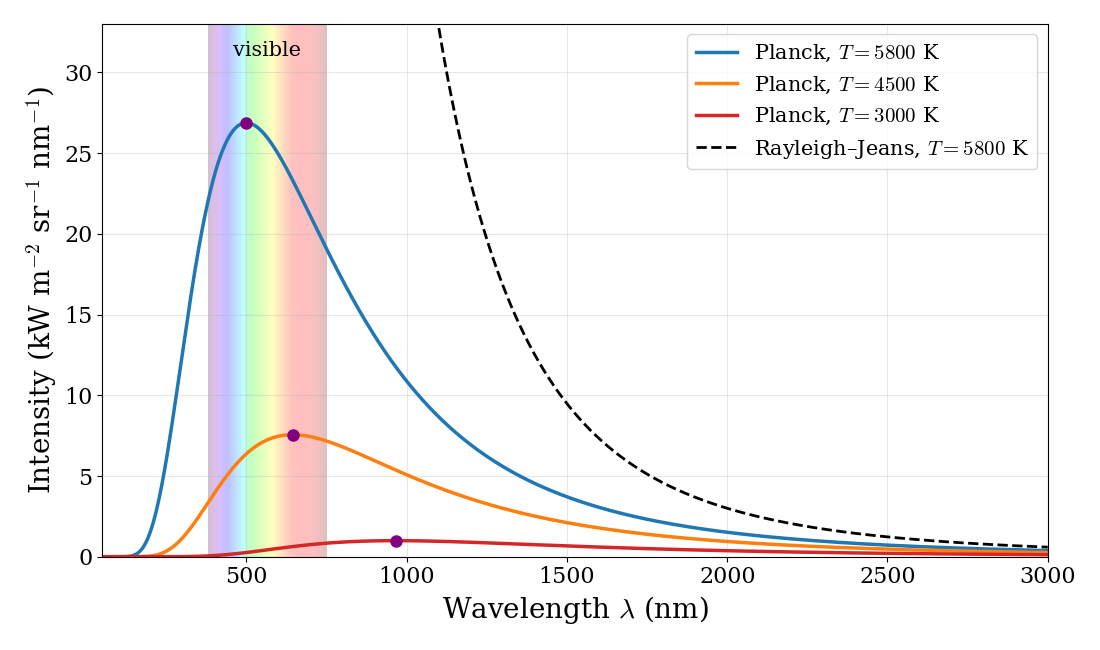
Using classical electromagnetism and classical statistical mechanics, Lord Rayleigh and James Jeans derived an equation for the intensity of the radiation emitted by a black body at temperature \(T\) as a function of the wavelength \(\lambda\). The result, known as the Rayleigh–Jeans law, is:
\[ I(\lambda,T)={\frac {2ck_{\mathrm{B}}T}{\lambda^{4}}}, \tag{2.1}\]
where \(I\) is the intensity of the radiation (more precisely, the power emitted per unit area of the emitting surface, per unit solid angle, and per unit wavelength, a quantity called spectral radiance), \(c\) is the speed of light, \(k_{\mathrm{B}}\) is the Boltzmann constant, and \(T\) is the temperature in kelvins. This formula works well at long wavelengths, but it fails dramatically at short ones (dashed line in Fig. 2.1). If we take the limit for \(\lambda \rightarrow 0\) in Eq. 2.1, we obtain \(I \rightarrow \infty\). In other words, the shorter the wavelength (towards the UV and beyond), the more radiation the black body should emit, and the total energy emitted over all wavelengths should be infinite. This prediction is clearly absurd: if it were true, every warm object would be emitting an infinite amount of energy as UV light, X-rays, and gamma rays. This failure of classical physics is called the ultraviolet catastrophe (or Rayleigh–Jeans catastrophe).
Max Planck solved the problem in 1900 by making an assumption that had no justification in classical physics: the energy of the oscillating electrons that emit the radiation cannot take any value, but only integer multiples of a minimum amount proportional to the frequency \(\nu\) of the radiation:
\[ E = n h \nu = n h \frac{c}{\lambda}, \tag{2.2}\]
with \(n\) a positive integer. With this assumption, Planck obtained the following formula for the intensity:
\[ I(\lambda ,T)={\frac {2hc^{2}}{\lambda ^{5}}}{\frac {1}{e^{hc/(\lambda k_{\mathrm {B} }T)}-1}}. \tag{2.3}\]
At short wavelengths, the exponential in the denominator grows much faster than \(\lambda^5\) decreases, and \(I\) goes to zero as \(\lambda \rightarrow 0\), in agreement with the experiments. (At long wavelengths, instead, \(e^{x}-1\approx x\), and Planck’s law reduces to the Rayleigh–Jeans law.) Physically, quantization works because at short wavelengths the minimum quantum of energy, \(hc/\lambda\), becomes much larger than the typical thermal energy, \(k_{\mathrm{B}}T\), and the high-frequency oscillations are simply too “expensive” to be excited. By fitting Eq. 2.3 to the experimental data, Planck also obtained the value of the new constant, \(h = 6.626 \times 10^{-34} \; \text{J s}\), which is now called the Planck constant.
Let’s look at what Fig. 2.1 tells us:
Color and temperature: as the temperature increases, the maximum of the curve moves to shorter wavelengths. The position of the maximum follows a simple rule, called Wien’s displacement law, which can be derived from Eq. 2.3: \(\lambda_\text{max}T = 2.898\times10^{-3}\;\text{m K}\). The surface of the Sun (\(T\approx5800\;\text{K}\)) has its maximum at \(\lambda_\text{max}\approx500\;\text{nm}\), in the middle of the visible region (our eyes evolved to see the light that the Sun emits the most). An incandescent light bulb (\(T\approx3000\;\text{K}\)) has its maximum at about \(970\;\text{nm}\), in the infrared, which is why it looks yellowish and why most of its energy is wasted as heat. Our bodies (\(T\approx310\;\text{K}\)) emit mostly at about \(9{,}000\;\text{nm}\), in the infrared, where thermal cameras can see it.
Brightness and temperature: the area under each curve, which is the total power emitted, grows very quickly with temperature (as \(T^4\), a result known as the Stefan–Boltzmann law). Doubling the temperature of an object makes it emit sixteen times more energy.
Where classical physics fails: the classical and quantum curves agree at long wavelengths, where the quanta \(h\nu\) are small compared to \(k_\mathrm{B}T\) and the energy behaves as if it were continuous. They disagree completely at short wavelengths, where the quanta are large. This is a pattern that we will see again: quantum effects become important when the spacing between energy levels is large compared to the thermal energy.
Planck himself considered quantization a mathematical trick rather than a property of nature, and the idea was not taken seriously until Einstein used it to explain the photoelectric effect.
2.3 The Photoelectric Effect
When light shines on a clean metal surface, electrons can be ejected from it. This phenomenon is called the photoelectric effect. It was first observed by Heinrich Hertz in 1887, and studied in detail by Philipp Lenard around 1900. Albert Einstein explained it in 1905, proposing that light energy is quantized into discrete particles, called photons, each with an energy proportional to its frequency.
To see why an explanation was needed, let’s start from the classical prediction. As we saw at the end of Chapter 1, in classical physics light is a continuous electromagnetic wave, and the energy that it delivers every second depends on its amplitude (its brightness, or intensity), and not on its frequency. If we apply this picture to the photoelectric effect, we expect the electrons in the metal to absorb energy from the wave continuously, and to be ejected when they have accumulated enough of it to escape the surface. A brighter light delivers energy faster, so the electrons should come out with more energy. In other words, the kinetic energy of the ejected electrons, \(K\), should be proportional to the intensity of the incident light, \(I_{\text{in}}\):
\[ K= c_{\text{PE}} \; I_{\text{in}}, \tag{2.4}\]
with \(c_{\text{PE}}\) being a constant that depends on the metal and on the characteristics of the incident light. The same picture also makes two other predictions: any color of light should be able to eject electrons, provided that it is bright enough, and with a very dim light the electrons should come out only after some delay, the time necessary to accumulate enough energy.
The experiments contradicted all three predictions. The kinetic energy of the ejected electrons does not depend on the intensity of the light at all (a brighter light ejects more electrons, but not faster ones), while it increases with the frequency of the light. Below a certain threshold frequency, which depends on the metal, no electrons are ejected, no matter how bright the light is. Above the threshold, electrons are ejected immediately, even with very dim light.
Einstein explained these results by proposing that a beam of light is not a continuous wave, but a stream of discrete packets of energy, the photons. The energy of each photon is equal to the smallest possible energy quantum in Planck’s theory of the black body (corresponding to \(n=1\) in Eq. 2.2):
\[ E = h \nu. \tag{2.5}\]
Each photon interacts with a single electron, and gives it all of its energy at once. If the energy of the photon is smaller than the energy required to remove an electron from the metal, called the work function, \(\phi\), the electron cannot escape, and since there is no way of accumulating the energy of several photons, increasing the intensity (i.e., the number of photons) does not help. If the energy of the photon is larger than the work function, the electron escapes immediately, and the extra energy becomes its kinetic energy. The maximum kinetic energy of the ejected electrons, \(K_{\text{max}}\), is therefore:
\[ K_{\text{max}} = E_{\text{in}} - \phi = h\nu_{\text{in}} - \phi, \tag{2.6}\]
which depends on the frequency of the light, but not on its intensity, in agreement with the experiments. Eq. 2.6 is plotted for three metals in Fig. 2.2. For each metal, \(K_\text{max}\) is zero up to the threshold frequency, \(\nu_0=\phi/h\), and then increases linearly with the frequency. The lines for all metals are parallel, since their slope is always the Planck constant, \(h\). In 1916, Robert Millikan measured these lines very carefully, confirming Einstein’s prediction and obtaining a value of \(h\) in agreement with Planck’s. Einstein received the Nobel Prize in Physics in 1921 for this explanation.
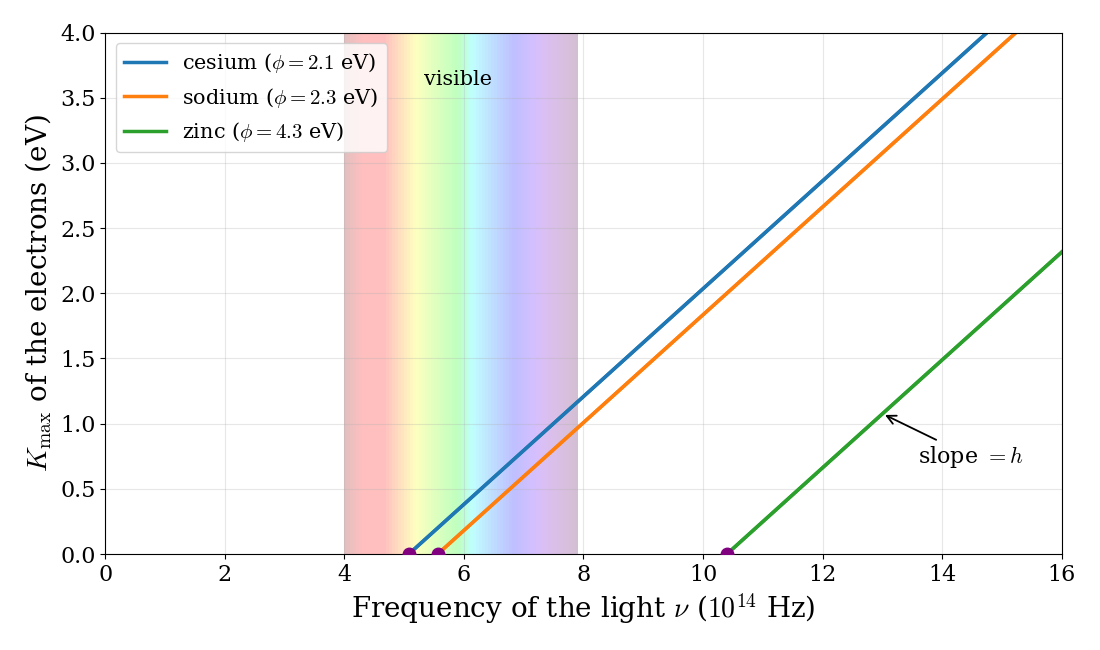
For example, the work function of sodium is about \(2.3\;\text{eV}\).1 The threshold wavelength is \(\lambda_0=hc/\phi\approx1240/2.3\approx540\;\text{nm}\), so green, blue, and violet light can eject electrons from sodium, but yellow and red light cannot, no matter how bright. Ultraviolet light with \(\lambda=250\;\text{nm}\) carries photons of \(4.96\;\text{eV}\), and ejects electrons with a maximum kinetic energy of \(4.96-2.3\approx2.7\;\text{eV}\), corresponding to a speed of about \(10^6\;\text{m/s}\).
2.3.1 Why chemists care about photons
The energy of a single photon looks tiny in joules, but chemists usually think in terms of moles. A photon of green light (\(\lambda=500\;\text{nm}\)) has an energy of \(E=hc/\lambda=3.97\times10^{-19}\;\text{J}\), or \(2.48\;\text{eV}\). A mole of such photons carries \(3.97\times10^{-19}\;\text{J}\times6.022\times10^{23}\;\text{mol}^{-1}\approx239\;\text{kJ/mol}\). This is the same order of magnitude as the energy of a chemical bond (a \(\mathrm{C}-\mathrm{C}\) single bond is about \(350\;\text{kJ/mol}\)). Ultraviolet photons (\(\lambda=250\;\text{nm}\), \(479\;\text{kJ/mol}\)) carry enough energy to break chemical bonds, which is why UV light causes sunburns and can be used to sterilize surfaces, while visible photons can only excite electrons in molecules (which is how our eyes, and photosynthesis, work), and infrared photons can only make molecules vibrate. The interaction between light and molecules, one photon at a time, is the basis of spectroscopy, which we will discuss in Chapter 13.
2.4 Atomic Spectra and the Bohr Model
The third failure of classical physics is the one that matters most for chemistry, since it concerns atoms themselves. When a gas of hydrogen atoms is heated or excited by an electric discharge, it emits light. If this light is passed through a prism, it does not produce a continuous rainbow, like the light from a black body, but a series of sharp lines, each with a precise wavelength. In the visible region, hydrogen emits only four lines: red (\(656\;\text{nm}\)), blue-green (\(486\;\text{nm}\)), violet (\(434\;\text{nm}\)), and deep violet (\(410\;\text{nm}\)). Every element has its own characteristic set of lines, which can be used to identify it, as a fingerprint (this is how helium was discovered in the spectrum of the Sun, before it was found on Earth).
In 1885, Johann Balmer found a simple formula that reproduces the wavelengths of the visible lines of hydrogen, and in 1888 Johannes Rydberg generalized it to all the lines of hydrogen, including those in the ultraviolet and infrared:
\[ \frac{1}{\lambda} = R_H\left(\frac{1}{n_1^2}-\frac{1}{n_2^2}\right), \qquad n_2 > n_1, \tag{2.7}\]
where \(n_1\) and \(n_2\) are positive integers, and \(R_H=1.0968\times10^{7}\;\text{m}^{-1}\) is the Rydberg constant for hydrogen. The lines with \(n_1=1\) are in the ultraviolet (the Lyman series), those with \(n_1=2\) are mostly in the visible (the Balmer series), and those with \(n_1=3\) are in the infrared (the Paschen series). For example, for \(n_1=2\) and \(n_2=3\), Eq. 2.7 gives \(1/\lambda=R_H\cdot\frac{5}{36}\), or \(\lambda=656\;\text{nm}\), the red line of hydrogen. The formula worked perfectly, but nobody knew why. Classical physics could not explain why atoms emit only certain wavelengths. Worse, as we mentioned at the beginning of this chapter, according to classical physics an electron orbiting a nucleus should continuously emit radiation of all wavelengths while spiraling into the nucleus.
In 1913, Niels Bohr proposed a model that explained the hydrogen spectrum by combining Rutherford’s nuclear atom with Planck’s idea of quantization. The Bohr model is based on two assumptions:
- The electron moves around the nucleus only on certain circular orbits, called stationary states, on which it does not emit radiation. On these orbits, the angular momentum of the electron is quantized: it can only be a whole multiple of \(\hbar=h/2\pi\), \(L=n\hbar\), with \(n=1,2,3,\ldots\)
- The atom emits or absorbs light only when the electron jumps from one orbit to another. The energy of the photon is equal to the difference between the energies of the two orbits, \(h\nu=E_{n_2}-E_{n_1}\).
Combining the first assumption with the classical laws of motion for an electron attracted by a proton (Coulomb’s law, Chapter 1), Bohr found that the allowed energies of the electron are:
\[ E_n = -\frac{m_e e^4}{8\varepsilon_0^2h^2}\frac{1}{n^2} = -\frac{13.6\;\text{eV}}{n^2}, \qquad n=1,2,3,\ldots \tag{2.8}\]
and the radius of the smallest orbit, now called the Bohr radius, is \(a_0=0.529\;\text{Å}\). The energy levels of Eq. 2.8 and the transitions between them are shown in Fig. 2.3.
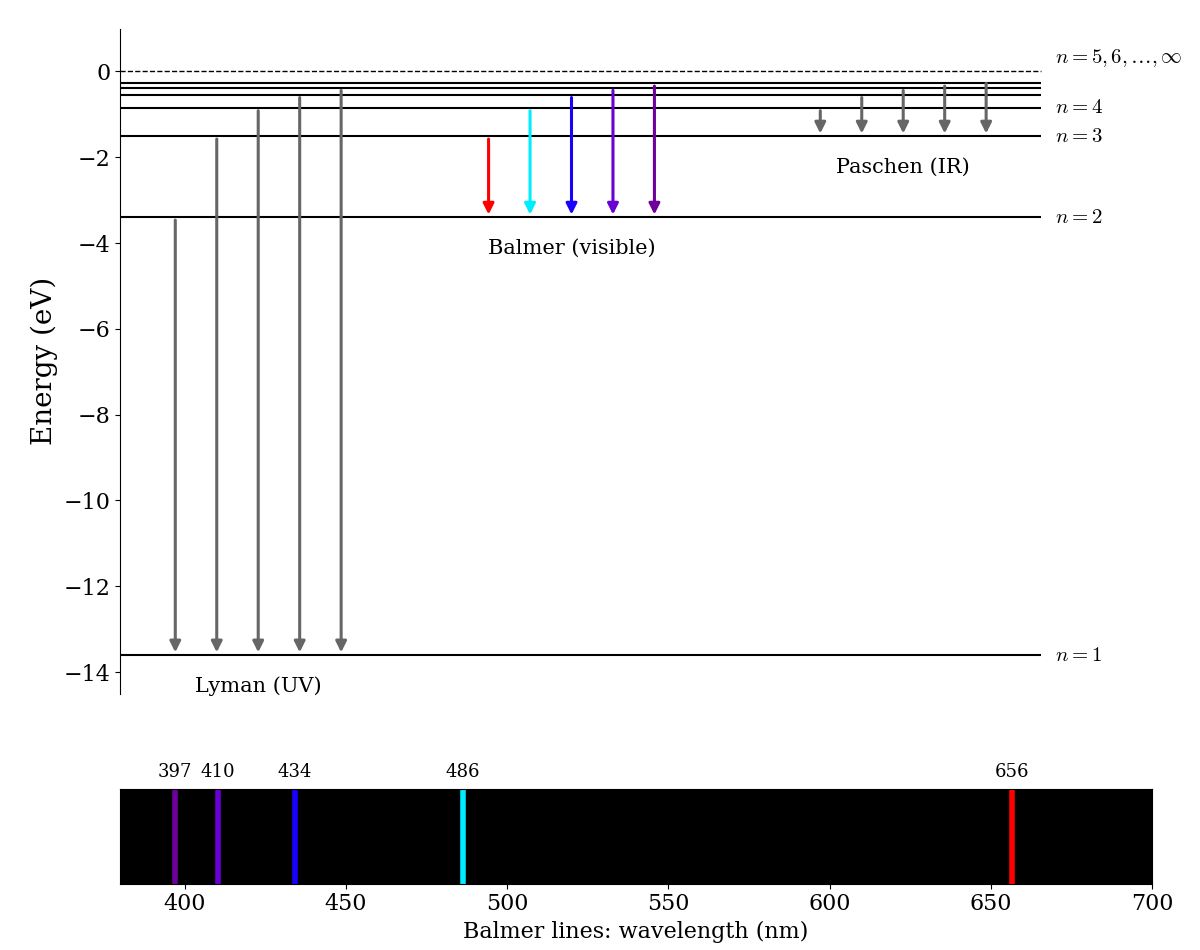
This diagram explains three features of atomic spectra:
Quantized energy levels explain line spectra: since the electron can only have the energies of Eq. 2.8, the photons emitted when it jumps from a higher level to a lower one can only have the energies \(E_{n_2}-E_{n_1}=13.6\;\text{eV}\left(\frac{1}{n_1^2}-\frac{1}{n_2^2}\right)\). Dividing by \(hc\) gives exactly the Rydberg formula, Eq. 2.7, with \(R_H=13.6\;\text{eV}/hc=1.097\times10^{7}\;\text{m}^{-1}\), in perfect agreement with the experimental value.
Ionization energy: the levels get closer and closer as \(n\) increases, and they converge to \(E=0\), which corresponds to the electron completely separated from the proton. The energy needed to remove the electron from the lowest level, \(13.6\;\text{eV}\) (or \(1{,}312\;\text{kJ/mol}\)), is the ionization energy of hydrogen, again in perfect agreement with experiments.
The meaning of the series: all lines of a series end on the same lower level. The Lyman series, which ends on \(n=1\), involves the largest energy jumps, and it is in the ultraviolet. The Balmer series, which ends on \(n=2\), involves smaller jumps, and its first lines are visible.
Despite this spectacular success, the Bohr model has serious problems. It works only for hydrogen and for ions with a single electron (such as \(\mathrm{He}^+\) and \(\mathrm{Li}^{2+}\)), and it fails already for the helium atom. It cannot explain the intensities of the lines, nor why some lines split in a magnetic field. Most importantly, it does not explain why angular momentum should be quantized, or why an electron on an orbit should not radiate: these are assumptions made to fit the data. As we will see in Chapter 5, the Schrödinger equation gives exactly the same energies as Eq. 2.8, but without any of these assumptions, and with a completely different picture of the electron, which is not a particle moving on an orbit, but a wave.
2.5 Wave-Particle Duality
If light is made of particles, these particles should also carry momentum, and Einstein showed that the momentum of a photon is:
\[ p = \frac{h}{\lambda}. \tag{2.9}\]
We can see where this result comes from in two steps. First, combining \(E = h \nu\) for a photon with \(\lambda \nu = c\) for an electromagnetic wave, we obtain the energy of a photon as a function of its wavelength:
\[ E = \frac{h c}{\lambda}. \tag{2.10}\]
Second, according to Einstein’s theory of relativity, the energy of a particle with no mass, such as a photon, is related to its momentum by \(E = pc\).2 Replacing this relation in Eq. 2.10 and solving for \(\lambda\) we obtain:
\[ \lambda = \frac{h}{p}, \tag{2.11}\]
which is equivalent to Eq. 2.9. Light, therefore, behaves as a wave in some experiments (it can be diffracted, and it has a wavelength) and as a particle in others (it comes in packets with energy \(h \nu\) and momentum \(h/\lambda\)). In 1924, Louis de Broglie made the bold suggestion that this dual behavior is not unique to light, and that matter should also behave like a wave, with a wavelength given by the same Eq. 2.11. In 1927, Clinton Davisson and Lester Germer confirmed de Broglie’s hypothesis by observing a diffraction pattern when they shot a beam of electrons at a nickel crystal, exactly as if the electrons were waves. We will discuss the wave behavior of electrons in more detail in Chapter 8.
Why don’t we notice the wave nature of everyday objects? Because \(h\) is so small. A baseball with a mass of \(0.145\text{ kg}\) thrown at \(40\text{ m/s}\) has a de Broglie wavelength of \(\lambda = h/mv \approx 1\times10^{-34}\text{ m}\), far too small to be observed in any experiment. An electron accelerated to a speed of \(10^6\text{ m/s}\), instead, has a wavelength of about \(7\times10^{-10}\text{ m}\), comparable to the size of an atom. This is why wave behavior dominates the world of electrons, atoms, and molecules, and why chemistry needs quantum mechanics.
Rewriting the previous equations in terms of the wave vector, \(k=\frac{2\pi}{\lambda}\), and the angular frequency, \(\omega=2\pi\nu\), that we introduced in Chapter 1, we obtain the following two equations:
\[ \begin{aligned} p &= \hbar k \\ E &= \hbar \omega, \end{aligned} \tag{2.12}\]
which are known as de Broglie’s equations. We will use these equations to develop wave mechanics in the next chapter.
2.6 Summary
The four experiments discussed in this chapter, and the new ideas that they introduced, are summarized in Table 2.1.
| Experiment | Classical prediction | Observation | Quantum idea |
|---|---|---|---|
| Black-body radiation | Intensity grows without limit at short wavelengths | Intensity peaks and goes to zero at short wavelengths | Energy is exchanged in quanta, \(E=nh\nu\) (Planck, 1900) |
| Photoelectric effect | Electron energy grows with light intensity; any color works | Electron energy depends only on frequency; threshold frequency | Light is made of photons, \(E=h\nu\) (Einstein, 1905) |
| Atomic line spectra | Continuous emission; electrons spiral into the nucleus | Sharp lines at specific wavelengths; atoms are stable | Atoms have quantized energy levels (Bohr, 1913) |
| Electron diffraction | Electrons are particles and cannot interfere | Diffraction patterns, as for waves | Matter behaves as waves, \(\lambda=h/p\) (de Broglie, 1924) |
The common thread of all these results is that, at the scale of atoms and molecules, energy is not continuous, and particles and waves are not separate categories. In the next chapter, we will see how Schrödinger combined these ideas into a single equation.
2.7 Chapter Review
2.7.1 Key Ideas
- Black-body radiation could only be explained by assuming that energy is exchanged in quanta, \(E=h\nu\) (Planck).
- The photoelectric effect showed that light is made of photons: the energy of the ejected electrons depends on the frequency of the light, not on its intensity.
- The sharp lines of atomic spectra show that atoms have discrete energy levels. The Bohr model explained hydrogen, but not why quantization happens.
- Particles behave as waves, with wavelength \(\lambda=h/p\) (de Broglie). The effect matters only for very light particles such as electrons.
- At the scale of atoms, energy is not continuous, and particles and waves are not separate categories.
2.7.2 Study Questions
1. What did classical physics (the Rayleigh–Jeans law) predict for the radiation emitted by a black body?
- the intensity peaks and then goes to zero at short wavelengths
- the intensity grows without limit at short wavelengths
- no radiation is emitted at room temperature
- the intensity is the same at all wavelengths
- only visible light is emitted
2. Which assumption did Planck introduce to explain black-body radiation?
- light travels faster at short wavelengths
- atoms have a nucleus
- energy is exchanged only in multiples of \(h\nu\)
- electrons are waves
- energy is not conserved in the emission of light
3. As the temperature of a black body increases, the maximum of its emission:
- moves to longer wavelengths
- moves to shorter wavelengths
- does not move
- disappears
- moves to longer wavelengths and becomes weaker
4. Light with a frequency below the threshold frequency shines on a metal. If we increase its intensity:
- still no electrons are ejected
- electrons are ejected with more kinetic energy
- electrons are ejected after a short delay
- more electrons are ejected, all with the same kinetic energy
- the threshold frequency decreases
5. In the photoelectric effect, the kinetic energy of an ejected electron is:
- proportional to the intensity of the light
- \(K=h\nu+\Phi\)
- \(K=h\nu-\Phi\), where \(\Phi\) is the work function of the metal
- the same for all frequencies above the threshold
- \(K=\Phi/h\nu\)
6. The energy of a single photon depends on:
- the intensity of the light
- the number of photons in the beam
- the temperature of the source
- its frequency only, \(E=h\nu\)
- the size of the source
7. What do the sharp lines in the spectrum of hydrogen tell us?
- that the electron spirals into the nucleus
- that hydrogen emits light at all wavelengths
- that light is a classical wave
- that the hydrogen atom has many electrons
- that the atom can only have certain discrete energies
8. Which of the following is a problem of the Bohr model?
- it works only for atoms with one electron, and its assumptions have no justification
- it cannot explain the lines of the hydrogen spectrum
- it predicts that atoms are not stable
- it gives the wrong value of the ionization energy of hydrogen
- it does not use Planck’s constant
9. The de Broglie wavelength of a particle with momentum \(p\) is:
- \(\lambda=hp\)
- \(\lambda=p/h\)
- \(\lambda=h\nu\)
- \(\lambda=c/p\)
- \(\lambda=h/p\)
10. Why don’t we observe the wave nature of a thrown baseball?
- because a baseball has no momentum
- because only charged particles have a wavelength
- because a baseball moves faster than light
- because its de Broglie wavelength is far smaller than any object or opening it could interact with
- because its de Broglie wavelength is too long to be measured
The electronvolt, eV, is the energy gained by an electron accelerated through a potential difference of 1 volt: \(1\;\text{eV}=1.602\times10^{-19}\;\text{J}\). It is a convenient unit for the energies of single electrons and photons. A useful shortcut for photons is \(E(\text{eV})\approx1240/\lambda(\text{nm})\).↩︎
This might be surprising, since in classical mechanics momentum is \(p=mv\), and a particle without mass should have no momentum. In relativity, however, momentum and energy are more general concepts, and a massless particle that always travels at the speed of light can carry both. The fact that light carries momentum can be measured directly: light pushes on the objects that absorb or reflect it, a phenomenon called radiation pressure.↩︎